
Dominic Banguis
•
•
4 min read


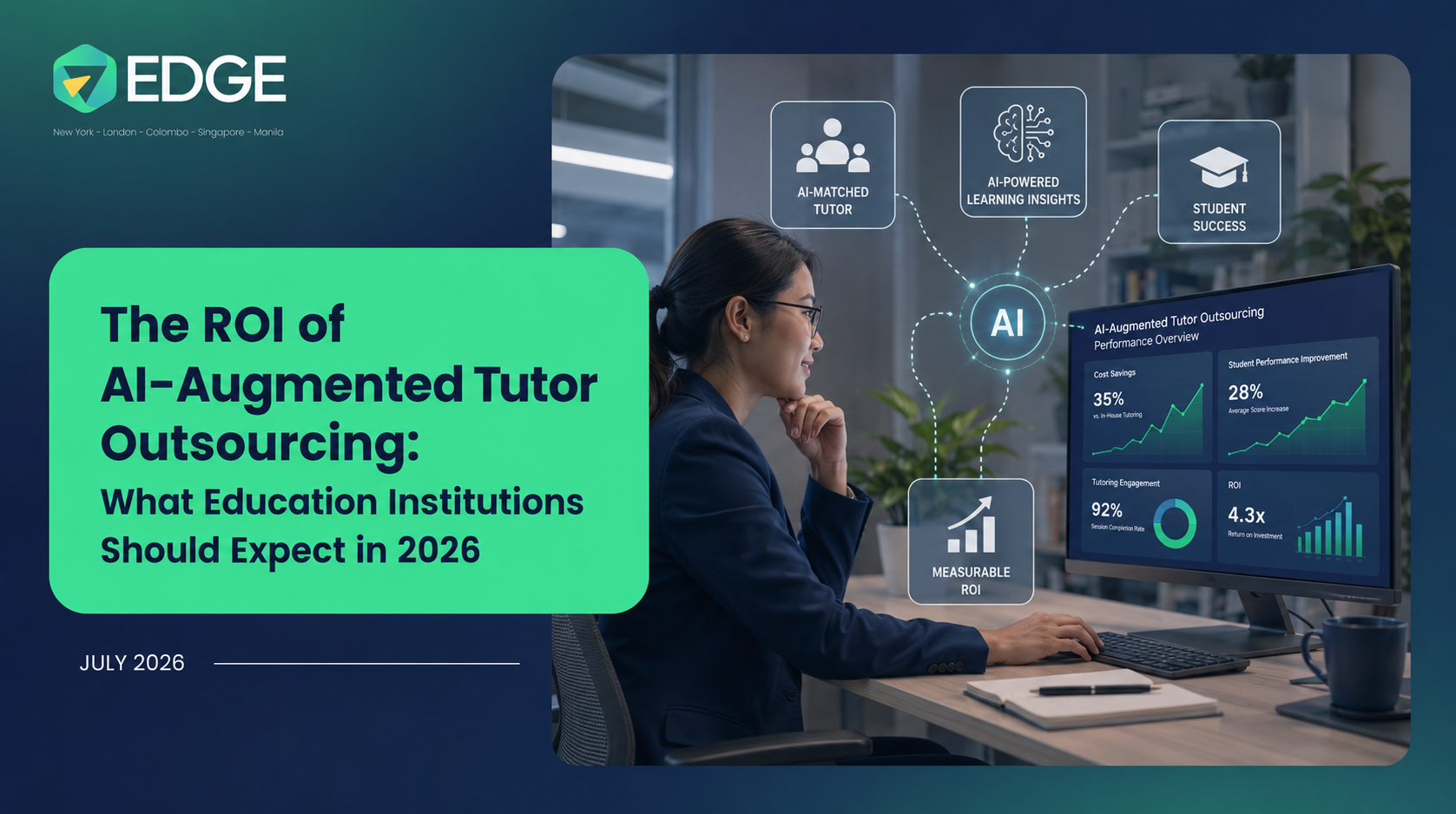
Institutions considering AI augmented tutor outsourcing are increasingly asking a fair and specific question: what should we actually expect to get back for this investment. The honest answer requires separating two different kinds of return that often get blended together in vendor pitches, direct academic outcome improvement, and operational efficiency gains that free up institutional staff time and budget for other priorities. Both are real and worth measuring, but they are not the same thing, and conflating them makes it harder to judge whether a specific partnership is actually delivering value.
AI augmented tutoring, done well, tends to show its clearest academic return in faster gap identification and more targeted intervention, rather than dramatically superior teaching quality compared to a strong non-AI enhanced program. This is an important distinction for setting realistic expectations. The AI component primarily improves how efficiently a tutoring program identifies and addresses need, not the fundamental ceiling of what skilled human tutoring can achieve.
Institutions should expect to see this show up as faster time to measurable progress on identified gaps, and more consistent outcomes across a larger student population, since AI supported quality assurance and gap identification reduce the variance that comes from relying purely on individual tutor judgment without data support. Institutions should be skeptical of any claim promising dramatically superior academic outcomes purely from AI augmentation, without a clear explanation of the underlying instructional mechanism producing that improvement.
These operational returns are frequently underweighted in ROI conversations, which tend to focus almost entirely on academic outcome data. For institutions with limited administrative capacity to manage an outsourced tutoring relationship, this operational efficiency can be a meaningful part of the overall value delivered, worth factoring explicitly into any ROI calculation rather than treating it as a minor side benefit.
Institutions sometimes expect ROI to become visible faster than is realistic, particularly for academic outcome measures that naturally take a full term or longer to show meaningful movement. Setting an honest timeline upfront, distinguishing between operational efficiency gains that may be visible within the first month and academic outcome gains that typically require a full semester or more to assess reliably, prevents both premature disappointment and unrealistic renewal pressure based on too short a measurement window.
A credible ROI assessment requires establishing a clear baseline before a program begins, not just measuring outcomes after the fact and assuming improvement is attributable to the tutoring partnership. This means capturing where students actually stood, on relevant assessments or progress measures, before the program started, and tracking the same measures at defined intervals throughout the engagement.
Institutions that skip establishing a genuine baseline often end up in an unproductive debate at renewal time about whether a program is actually working, since there is no clear before and after comparison to point to either way.
A few patterns are worth treating skeptically when a tutoring provider presents ROI data during a sales process. Aggregate outcome statistics without any comparison baseline, since impressive sounding numbers are meaningless without knowing where students started. Case studies drawn only from the provider strongest performing institutional partnerships, without disclosure of how representative those results actually are. And ROI claims that conflate academic outcomes with softer, harder to verify metrics like general satisfaction scores.
Providers confident in their actual results are typically willing to share methodology details and, where appropriate, connect a prospective institutional partner with an existing client for a direct reference conversation, rather than relying solely on polished case study summaries.
EDGE Tutor works with institutional partners to establish a clear baseline before a program begins, and reports against both academic outcome measures and operational efficiency metrics throughout the engagement, so the actual return on an AI augmented tutoring investment is visible and verifiable, not just asserted. We are glad to walk prospective partners through our measurement methodology and connect them with existing institutional partners for a direct conversation.
Want a clear, honest picture of what ROI to expect from AI-augmented tutor outsourcing? Talk to EDGE Tutor about how we measure and report results for institutional partners.